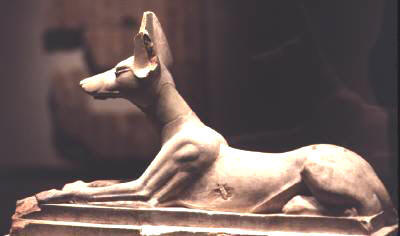
This fascinating breed is one of the
oldest breeds in the world. They brought
to the shores of the Nile in Central
Africa as a gift to Pharaoh. Basenji
type of dogs appears in Egyptian
hieroglyphs and some artwork.
General
Basenji
is a dog that
DOESN’T
bark
but
that
does not mean
that it is completely
mute.
He cannot
bark
like an ordinary
dog,
but
can produce
only
a short
"Woolf".
They
may whine,
growl and
howl
like a
wolf,
and
when
they do it
can
be quite
loud.
|
 |
The
Basenji breed is one that people
tend to think is perfect for a
pet or totally impossible. They
seem to be one of the smartest
or one of the dumbest breeds
depending on your outlook.
Basenji
dog
is still
to be
calm,
quiet and
loyal
pet.
Considered to be
highly
intelligent,
resourceful
and
super
smart
dogs.
Their
intelligence
is very often
interpreted as
stubbornness.
Generally
they are very
curious,
playful
dogs
full of energy.
Can be aloof with strangers.
They have a
lot
of cat
characteristics,
such
as
independence and
indifference,
and,
just like
cats,
they
keep themselves
clean.
They are not
water lovers,
and don’t like rain
or
wet
soil.
Mainly
they will
avoid
going out
during the
rainy
time
and would rather
stay
at home
all day,
where is
dry and
warm. |
This is an elegant
dog, aristocratic
look
with wrinkles
on the
forehead.
Large
erect
ears,
dark
almond-shaped
eyes
create
a typical
absent and
thoughtful
look.
Another
distinguishing feature
of the breed
is
tightly
curled
tail (single or double curl) lay on
his back.
Size
Basenji
isn’t
a big
dog.
Females grow 40
cm,
weighing
around 9.5 kg.
Males
are slight larger,
up to 43
cm
and weighing
around
11
kg.
Usually
tolerated
deviation from
centimeter or
two, and
everything else
is considered very
high
or i.e.
very low.
The most common
colors
are red,
but
FCI (Fédération
Internationale
Cynologique)
recognizes
also black,
tricolor
and brindle.
AKC
(American
Kennel
Club)
recognizes the
fifth color –
Trindle,
tricolor with brindle points.
White markings
are required
on the feet,
chest
and tail tip,
and
allowed
on
the
head and
neck.
White on
colored
areas (e.g.
on the back)
are considered to being error
but the reverse
is allowed,
i.e.
red
stains
on the white
parts
(usually
on
the neck).
Health
As for
health concerns,
they are
mainly
healthy
dogs.
Abroad
are required to
test for
Fanconi
Syndrome
(DNA
test).
In addition
to
mandatory
and
meaning hip
and
eye examination,
this shows only the current state and must
be repeated every so often.
Umbilical
hernia is
very common in Basenjis,
and
according to some estimates
there are
about 50%
Basenji with it,
which
is usually not a
problem
for
a normal life,
but
if umbilical
hernia is quite big than the
surgery is highly recommended.
Usually
they live
around 14
years and
some
are known
to
live
up to
17 years.
Care
|
 |
Basenji
care
is not difficult.
Their coat
is short,
generally without
undercoat.
Just
brush
them
during
shedding, which
is usually
less intense
than in
other breeds.
Basenji
is known as a very
clean
dog
-
cannot stand
dirt
or
wet
hair
and will
be
licking
like a cat
until it is
cleaned
and
dried.
Basenji
will
also
lick other
members of their pack,
and this
applies
to humans
and
animals.
Bathing
them
is almost
unnecessary
because apart from
the fact that
they are
clean,
Basenji
is also known
that has no
odor.
Basenji
is
a dog that
must be kept inside of the house
or apartment.
Unlike other female dogs Basenji
comes in heat once a year. In
the northern hemisphere they
seasoning in autumn while
puppies born between November
and January. In the southern
hemisphere, females are in heat
in spring, and the puppies are
born in June or July. Sometimes
females can season two times a
year, but this spring heat
usually turns out to be a false.
|
Training
|
Training
Basenji is
not an easy
job.
It is necessary to
devote
considerable time and
a lot of effort
and
patience
with the appropriate
stimulus.
Only in this
way
you can train
their
apathy
and indifference.
This
is not a dog
that will
blindly
obey orders
and cannot
wait to
do something
for
his master,
but
despite all this,
one can
study
and learn to
perform various
tricks,
but with the
right motivation,
otherwise it
will very
quickly begin to
tease.
Basenji
is a
hunting dog originated
in Central
Africa and
is still used
as Pygmies hunting
dog.
While
most dogs are
hunted
with the aid
of sight and smell
Basenji
uses
both
senses
to
spy
their prey.
In Africa,
it's often
used to
help
in the hunt
like
find
and
chasing
wild animals
into nets
that were
stretched
on the bushes.
|

|
Out of
Africa
is mainly
a pet,
hunting
is rarely used.
He’s excellent
in
lure
coursing
and
racing,
and sometimes
competes
in
agility.
Outside
Basenji
active dog
always ready
for action,
long hours of
walking, running
and hunting.
But at home
is generally
a quiet
pet
that likes to be
near his
family
lying
on a couch
near to their
owners
or
other animals.
He loves
to
sunbathe
and
will
move
from one room
to another
catching
sun
spots.
He doesn’t like
winter,
cold
or
rain,
and during
winter
will
usually
be reduced to the
barest
outings
and more or less
sleep over
the winter
with a
hot
radiator
or
under the covers.
|
Can
be aloof with strangers
but with
little food
becomes their
best friend
and, of course,
just
as they have
food.
Attitude towards
strange
dogs
depends on a
Basenji.
There is a chance
to be aggressive to dogs with
same sex and can
have difficulty to
accepting
new dogs when grow up.
Early
socialization
and company with other dogs
is highly recommended,
so they can, as
puppies
get to know
other dogs as many as
possible. They
have a very good memory and will
be good friend with dogs they
likes to play, even if they are
not seen for years. On the other
hand, if they don’t like one
specific dog for some reason, it
is almost
impossible to ever be friends
with him. |

|
Basenjis do well with other pets (cats) if
they growing up with them from early age.
Basenji in Croatia
First Basenji in Croatia came in mid 90-ies
of the last century. The HKS has so far
registered 30-odd Basenjis. Because some of
them sold overseas, and some are already
dead, in Croatia there are today around
15-20, mostly in the northern parts (most of
them in Varazdin, Zagreb ...)
With the
amount of effort
Basenji
becomes perfect
and wonderful
pet
and friend.

|
Country of origin:
Height:
Weight:
Coat:
Color:
Temperament:
|
Republic of Congo
Females - 40 cm, males - 43 cm
Females – around 10 kg, males -
around 11kg
Short, pliant and fine.
Red, black, tricolor and brindle
An intelligent, independent, but
affectionate and alert breed
Can be aloof with strangers |